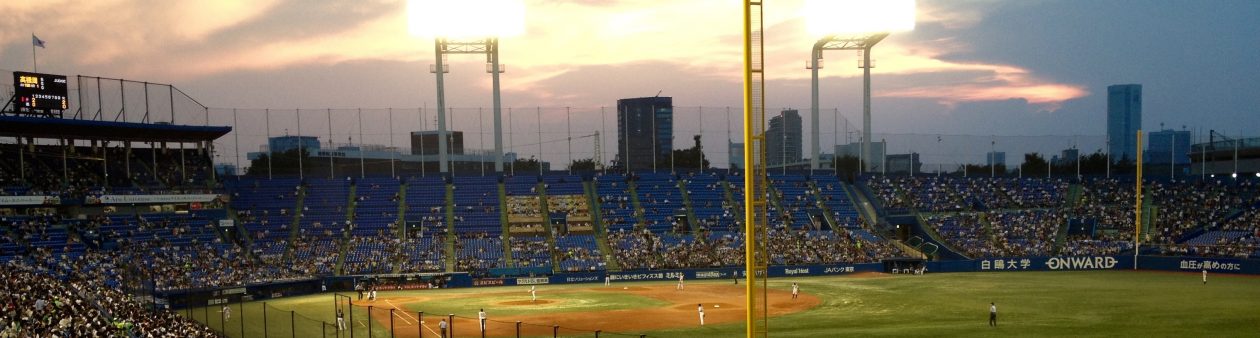

With Japan’s All-Star games coming up on Wednesday and Thursday, it is worth mentioning that the Central League will field four non-domestic signings on its roster, one short of the five players originally selected to play. The record for either league is six, set by the CL in 2014 and tied seven years later.
The number of imports on this year’s all-star rosters is of little real importance, except that NPB’s limits on foreign-player participation in its summer exhibitions highlights a question that plagues Japan now more than at any time in its past: What in the heck should the country do about non-Japanese?
Japan’s brand
It is no surprise that Nippon Professional Baseball has struggled with this issue since Japan has long invested heavily in branding itself as a nation with a homogeneous population comprised of ethnic Japanese–regardless of the fact that a huge number of Japanese citizens are not.
Among Japanese nationals are indigenous peoples, the Ainu from Hokkaido and Ryukyu Islanders from Okinawa, along with a huge number of ethnic Koreans and Chinese whose ancestors were born here, as well as more recent naturalized immigrants.
On Sunday, an election for one half of Japan’s legislative upper house, the House of Councillors, dealt hand-puppet Prime Minister Shigeru Ishiba’s ruling coalition a severe blow, but the election also demonstrated voters’ current enthusiasm for rejecting foreign nationals.
The biggest winner in the election was the radical right-wing populist Sanseito Party, whose leader is a huge Trump fan who advocates restricting foreigners’ freedoms and public benefits.
Like most industrialized nations, Japan suffers from labor shortages due to its rapidly aging population and record low fertility rates, and the obvious solution is to lure more immigrants.
But with overseas visitors at an all-time high, due to the weakest yen in 40 years, the shear visibility of non-Japanese walking the streets these past few years has encouraged politicians to compete among themselves to see who can call for the most severe restrictions on foreign nationals.
Stories about the danger of immigration and tourism are resonating with many because Japan long branding itself as a homogeneous population, ignoring the fact that the fears are exaggerated and that Japan’s homogeneity is simply a label and not a representation of reality.
Japanese baseball’s racist underpinning
In the same way, Japanese pro baseball has long branded itself as a showcase for a style of play that is uniquely suited to Japanese. Japan does have a definite style, a small-ball, slap-and-run norm that stems from kids being taught to play that way. But the big thinkers behind Japan’s baseball dogma would have you believe it is genetically pre-determined, as if the day baseball was first played on these shores, the sun goddess Amaterasu had long ago foretold how Japanese should play.
This is reminiscent of the “nihonjinron” ethnocentric nationalistic thinking that was so common to explain Japan’s sudden surge in wealth in the 1980s as a result of Japan’s genetic and cultural superiority. Not surprisingly, when Tokyo’s real estate bubble burst in the early 1990s and the economy crashed, Japan’s supposed genetic and cultural superiority proved completely unable to right the ship, and the economy has remained stagnant ever since.
Since the first time I began questioning Japanese baseball people about their game in relation to the style they observed in MLB, literally a hundred different people have said, “MLB is about power and speed.”
What sounds at first like a complement implies that MLB’s quality depends on players who are genetically bigger and stronger, but who lack the dedication to the game’s details that are routine for Japanese. In other words, “They are bigger and stronger than us, but we are superior in every other area.”
Japan’s baseball’s difference stems from culture and social norms, not genetics. Young children are taught not to drive the ball but to hit it to the left side of the infield because opposing children are poor fielders and the long throw to first makes it a higher-percentage play than trying to hit for extra bases.
But the idea that Japanese are unique and different has fueled a kind of Jim Crow ideology that Japanese fans only want to see Japanese play. This has led NPB to brand imports’ as “helpers” whose value is purely to help the Japanese players — that the fans really pay to see – win a championship.
In its early years, when some NPB owners still dreamed of a day when Japanese clubs could match MLB teams in terms of quality, quotas were attributed to the belief that only way to raise the level of domestic talent was to limit the number of foreign roster spots.
Thus, one month before the U.S. occupation of Japan ended on April 28, 1952, NPB began implementing its Jim Crow quotas, restricting the number of imports under contract at any one time. Since 1996, roster restrictions were replaced by limits on the active roster, which is where we are now.
Having watched NPB up close since 1984, I can tell you the game now is vastly better than it was 40 years ago, and that it has grown by leaps and bounds since the restrictions on imports have been relaxed, because imports made the level of competition here higher. Import players respecting Japan’s differences and embracing the lessons they could learn here have dramatically raised the bar for domestically produced players.
All-star stupidity
This idea, that Japanese fans only REALLY want to watch Japanese players reached its idiotic conclusion in the all-star games, which annually limit the number of imports available to each league, because really, who cares if the best players can’t compete if they are not Japanese, right?
For years, NPB rules required import players be deselected if the number selected by fans exceeded the quota. This last happened in 1980, when the fans voted three imports to the Pacific League team, and first baseman Tony Solaita was “unvoted” off the squad and replaced by a Japanese because each team could only have two.
A three-dimensional path
I am now back teaching English for the first time in over 25 years, and my lone student is a doctor with a knack for seeing binary arguments in three dimensions.
When asked how Japan can maintain its current economic levels without more immigrants, he said one needs to ask whether maintaining “current economic levels” is in the best interest of current residents if Japan is unable to close the mental gap between its homogeneous branding and the public’s awareness of the need for foreign labor.
Dialog in the hopes of confronting real issues, he said, is a potential path forward.
I would offer the same recommendation to NPB. The owners need to stop trying to protect the status quo and abandon their assumptions about what fans want. If they do that and take off their blinders, they may begin seeing different ways forward.
