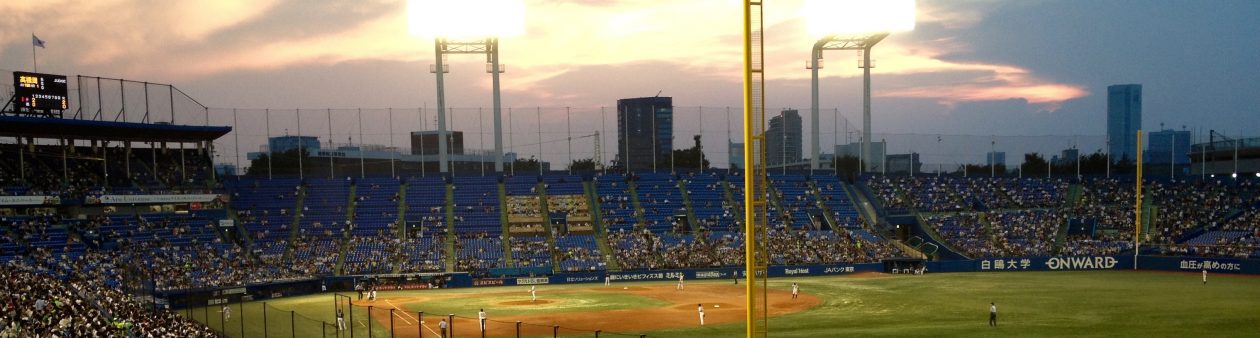
The SoftBank Hawks reached Japan’s season finale having won their last five regular-season games and their first three postseason games. They also started Game 1 at Yokohama Stadium with a 12-game Japan Series win streak dating back to 2018’s Game 3 against Hiroshima.
Former Texas Ranger Kohei Arihara, backed by the Hawks’ impressive defense, proved to be the difference in Saturday’s 5-3 Game 1 victory. Arihara drove in his first two runs as a pro to open the scoring against Andre Jackson, and SoftBank tacked on three more in the ninth before DeNA held Roberto Osuna’s feet to the fire in a three-run ninth.
This is part 2 of my lists of the most effective pitches thrown in Japan in the 2024 regular season. “Best” is subjective, but these pitches were the most effective in terms of their influence on game situations, by leading to better or worse counts or having worse results when put in play.
In Part 1, I explained the way the evaluations were created, and included the top 10 pitches overall, the top fastballs, and the top sliders.
Part 2 starts with Japan’s favorite secondary pitch, the splitter. For the most part, I have stuck with the SpoNavi website’s name for each type of pitch, except when Delta Graphs, which is more rigorous, is obviously talking about the same pitch as something else. The changeup of Hiroshima’s Allen Kuri is listed as a splitter by DG and so I’ll list that here.
Top 10 Splitters
Player
Team
Avg. Val
Miss Pct.
Avg. Velo
Tomoyuki Sugano
G
-.032
36.9
138.5
Carter Stewart Jr.
H
-.028
42.6
135.4
HIroto Takahashi
D
-.026
34.5
143.0
Iori Yamasaki
G
-.023
37.9
137.2
Allen Kuri
C
-.021
34.7
126.8
Kona Takahashi
L
-.019
29.8
141.5
Shoma Kanemura
F
-.018
29.7
140.3
Tomohisa Ozeki
H
-.017
24.5
131.5
Roki Sasaki
M
-.017
54.5
142.1
Kazuya Ojima
M
-.014
27.3
135.1
Next up are the top curveballs of 2024, a list that definitely has a hawkish lean to it…
Top 10 Curves – minimum 100 pitches
Player
Team
Avg. Val
Miss Pct.
Tomoyuki Sugano
G
-.027
22.1
Shoki Murakami
T
-.023
5.0
Shumpeita Yamashita
Bu
-.019
23.0
Livan Moinelo
H
-.018
27.0
Shuta Ishikawa
H
-.017
28.2
C.C. Mercedes
M
-.014
31.4
Carter Stewart Jr.
H
-.014
21.4
Yuito Mori
BS
-.013
31.4
Natsuki Takeuchi
L
-.012
26.4
Chihiro Sumida
L
-.011
28.4
Now to the cutters, where the No. 1 pitcher, rookie Teruki Yoshino, just scraped over the minimum, but it perhaps explains why he started Game 5 of the CL playoffs’ final stage…
Top 10 cut fastballs – minimum 150 pitches
Player
Team
Avg. Val
Miss Pct.
Avg. Velo
Teruki Yoshino
BS
-.043
22.2
137.5
Kohei Azuma
BS
-.038
19.8
138.5
Shoma Kanemura
F
-.029
21.7
138.1
Kohei Arihara
H
-.028
13.2
142.5
Sachiya Yamasaki
F
-.025
12.0
129.0
Jeremy Beasley
T
-.024
20.4
140.6
Ryusei Kawano
F
-.024
37.8
137.2
Naofumi Kizawa
S
-.021
48.3
139.6
Hayato Yuge
E
-.020
19.8
130.4
Iori Yamasaki
G
-.019
27.9
134.4
Yutaro Watanabe
L
-.019
16.9
137.8
Top 10 2-seam fastballs – minimum 100 pitches
Player
Team
Avg. Val
Miss Pct.
Avg. Velo
Takuma Kirishiki
T
-.040
11.6
147.2
Haruto Takahashi
T
-.032
19.4
139,4
Allen Kuri
C
-.032
21.0
130.3
Kohei Arihara
H
-.030
8.3
145.5
Keisuke Izumi
G
-.028
25.0
138.0
Patrick Murphy
F
-.028
15.7
154.0
Luis Perdomo
Bu
-.028
14.3
147.9
Albert Abreu
L
-.027
20.3
155.6
Kotaro Otake
T
-.024
6.1
132.1
Daiki Tajima
Bu
-.024
15.9
138.1
Andres Machado
Bu
-.024
22.2
154.6
Delta Graphs categorizes Allen Kuri’s shoot as a two-seamer, but the shoot was much less effective than the two-seamer (+.006 as opposed to -.032).